-
Mallard Duck and Duckling
Photograph by Anthony Peritore
Since 2004, mallard ducks have been coming to the courtyard of the National Geographic Society headquarters, an urban oasis in downtown Washington, D.C. In spring 2011, a female mallard and her ten newborn ducklings made their home here.
-
Duckling Watch
Photograph by Anthony Peritore
National Geographic engineering’s Ted Johnson watches over the ducks in the courtyard. Johnson was one of several staff members who took responsibility for ensuring the ducks’ safety amid delighted visitors and employees—and the occasional news crew.
When the mallard family arrived from a nesting site down the street, Society staff “initially [looked] at transporting them to a different location that would be healthier for them,” said National Geographic General Services Manager Michael Curry, nicknamed the “Duck Whisperer” by fellow staff members. Curry consulted with national and local wildlife experts, who said the ducklings would have the highest chance of survival if they remained in the environment chosen by the mother.
-
Ducklings Preening
Photograph by Anthony Peritore
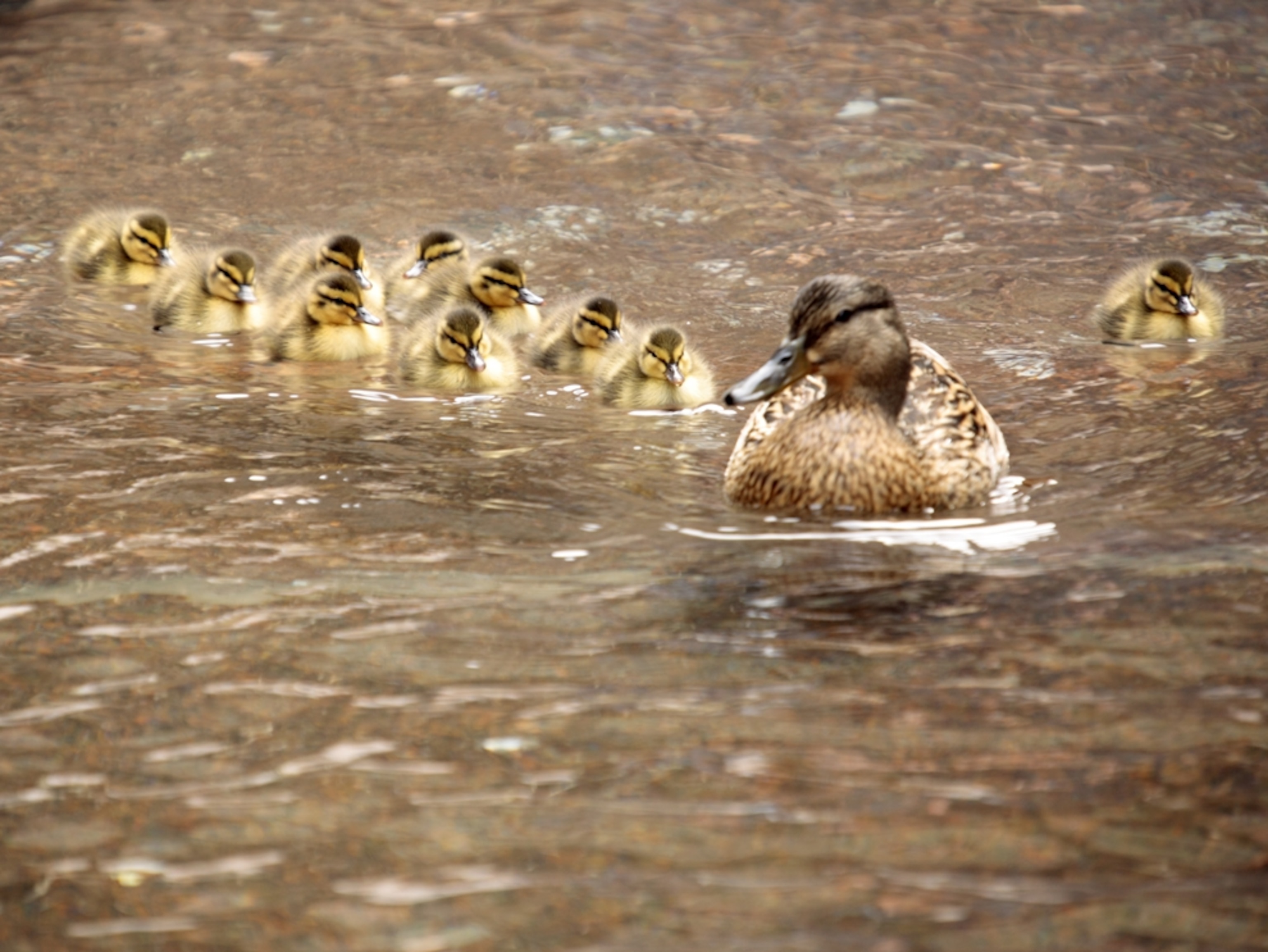
The ducklings stayed close together and were constantly supervised by their mother. National Geographic staff posted signs asking visitors not to feed the birds and to stay at least ten feet from the ducklings to prevent the mother from abandoning her brood.
-
Ducklings
Photograph by Anthony Peritore
The path to water was sometimes a slippery slope for the ducklings. The family enjoyed free reign of National Geographic’s courtyard, setting out for frequent swims in the fountain and resting in shady, landscaped areas that were blocked off for their safety.
-
Duck Family Outing
Photograph by Anthony Peritore
Ducklings follow the lead of their mother, making their way for a dip in the fountain.
Their excursions delighted many daily visitors, including National Geographic employees. “I know that a lot of staff really go out of their way to check on them, or come by deliberately in the mornings to check to see if they’re still there,” said Curry. “They are cute.”
-
Ducks in a Row
Photograph by Anthony Peritore
Ducklings enjoy a swim in the fountain with their mother, who bears all the responsibility for raising them. The father “does stay close by,” Curry said. Two males were spotted visiting the courtyard, but only one appeared to be mature enough to be the ducklings’ father.
-
Ducks to Water
Photograph by Anthony Peritore
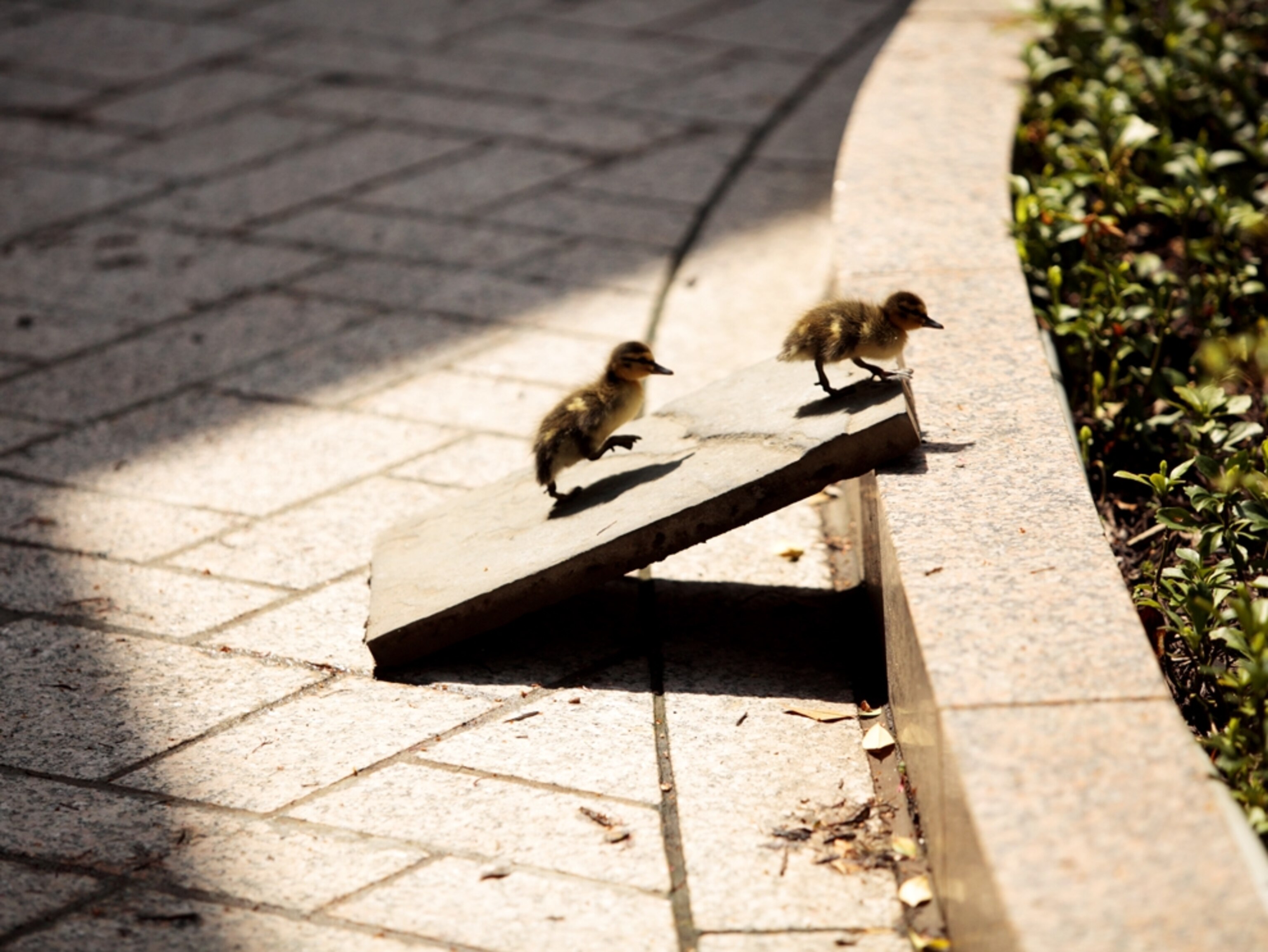
Ducklings take a break on a ramp built especially for their easy access to and from the water. “Our Engineering department found the ducks in the water and they couldn’t get out, so they found this piece of stainless steel to make a ramp for them,” Curry said.
-
Mallard Duck and Ducklings
Photograph by Anthony Peritore
With the help of their mother, two ducklings make their way up the ramp after a swim.
-
Mallard Ducklings
Photograph by Anthony Peritore
Mated mallard pairs migrate to and breed in the northern parts of their range and build nests on the ground or in a protected cavity. Females normally lay about a dozen eggs, and the incubation period lasts just under a month.
-
Ducks on a Ramp
Photograph by Anthony Peritore
Two ducklings march into the undergrowth after a swim in the fountain. Makeshift ramps sized for duckling use and placed around the courtyard eased the family’s passage along regular routes.
-
Ducklings Eating
Photograph by Anthony Peritore
Despite a relatively sheltered city upbringing, six of the ducklings were lost, felled by predators, the elements, and other dangers. According to experts, such losses are normal for a brood of this size.
Here, the four remaining ducklings feed from a tray set out in the courtyard. After the mother made an attempt to take her ducklings across a busy intersection one evening, staff members discovered that she had been fed at her nearby nesting site and was trying to return there. In order to keep the ducks from heading into the street, Curry began putting out food for them. City Wild Life, one of the organizations advising the Society on duck care, provided special food that is served in a shallow tray of water, a method that teaches the ducklings how to eat as they would in a pond.
After a particularly busy late April weekend at National Geographic headquarters, the mother duck relocated her four remaining ducklings several blocks away to Lafayette Square, a national park near the White House, where they appear to be adapting quite well.
Animals
-
Aardvark
-
Adélie Penguin
-
African Elephant
-
African Lion
-
African Wild Dog
-
Albatross
-
Alligator Snapping Turtle
-
Amazon Horned Frog
-
American Alligator
-
American Bison
-
American Bullfrog
-
American Crocodile
-
Ammonite
-
Andean Condor
-
Anglerfish
-
Ankylosaurus Magniventris
-
Ant
-
Arabian (Dromedary) Camel
-
Arctic Fox
-
Arctic Hare
-
Arctic Skua
-
Armadillo
-
Asian Elephant
-
Asian Lion
-
Atlantic Bluefin Tuna
-
Atlantic Puffin
-
Aye-Aye
-
Baboon
-
Bactrian Camel
-
Bald Eagle
-
Baltimore Oriole
-
Beaver
-
Beluga Whale
-
Bengal Tiger
-
Bird of Paradise
-
Black Bear
-
Black-Footed Ferret
-
Black Mamba
-
Black Rhinoceros
-
Blacktip Shark
-
Black Widow Spider
-
Bluebird
-
Blue Crab
-
Blue-Footed Booby
-
Blue Jay
-
Blue Marlin
-
Blue Whale
-
Boa Constrictor
-
Bobcat
-
Bottlenose Dolphin
-
Box Jellyfish
-
Brachychampsa Montana
-
Brown Bear
-
Bull Shark
-
Burmese Python
-
Butterflyfish
-
California Condor
-
California Sea Lion
-
Canada Goose
-
Cane Toad
-
Canvasback
-
Caribou
-
Carolina Wren
-
Cheetah
-
Chimpanzee
-
Chipmunk
-
Cicada
-
Clouded Leopard
-
Clown Anemonefish
-
Coelacanth
-
Common Earthworm
-
Common Loon
-
Common Octopus
-
Common Sandpiper
-
Common Vampire Bat
-
Common Wombat
-
Coral
-
Cottontail Rabbit
-
Coyote
-
Cretoxyrhina Mantelli
-
Cuban Screech Owl
-
Cubera Snapper
-
Deer Tick
-
Devil Frog
-
Dingo
-
Dog Snapper
-
Dolichorhynchops Osborni
-
Domestic Cat
-
Domestic Dog
-
Draco Lizard
-
Dugong
-
Eastern Coral Snake
-
Eastern Diamondback Rattlesnake
-
Eastern Gray Kangaroo
-
Egyptian Giant Solpugid (Camel Spider)
-
Electric Eel
-
Elephant Seal
-
Elk
-
Emperor Penguin
-
Fennec Fox
-
Firefly (Lightning Bug)
-
Flying Fish
-
Flying Snake
-
Fossa
-
Frilled Lizard
-
Fur Seal
-
Galápagos Tortoise
-
Gelada
-
Gentoo Penguin
-
Geographic Cone Snail
-
Giant Anteater
-
Giant Clam
-
Giant Pacific Octopus
-
Giant Panda
-
Giant River Otter
-
Giant Squid
-
Gibbon
-
Gila Monster
-
Giraffe
-
Golden Cowrie
-
Golden Eagle
-
Golden Jellyfish
-
Golden Lion Tamarin
-
Golden Poison Dart Frog
-
Gray Whale
-
Great Blue Heron
-
Great Egret
-
Greater Flamingo
-
Greater Rhea
-
Great Horned Owl
-
Great White Shark
-
Green Anaconda
-
Green Basilisk Lizard
-
Green-Eyed Tree Frog
-
Green Iguana
-
Green Sea Turtle
-
Grizzly Bear
-
Groundhog
-
Hammerhead Shark
-
Harbor Porpoise
-
Harp Seal
-
Hawaiian Monk Seal
-
Hawksbill Sea Turtle
-
Hedgehog
-
Henodus Chelyops
-
Hesperornis Regalis
-
Hippopotamus
-
Honeybee
-
Horned Toad (Short-Horned Lizard)
-
Hornet
-
Horse
-
Howler Monkey
-
Humpback Whale
-
Impala
-
Indian Rhinoceros
-
Ivory-Billed Woodpecker
-
Jackrabbit
-
Jaguar
-
Kemp's Ridley Sea Turtle
-
Killer Whale (Orca)
-
King Cobra
-
King Vulture
-
Kinkajou
-
Koala
-
Komodo Dragon
-
Krill
-
Ladybug
-
Laughing Kookaburra
-
Leafy and Weedy Sea Dragon
-
Leatherback Sea Turtle
-
Leopard
-
Leopard Seal
-
Leptoceratops Gracilis
-
Lesothosaurus Diagnosticus
-
Lionfish
-
Little Red Flying-Fox
-
Llama
-
Lobster
-
Locust
-
Loggerhead Sea Turtle
-
Lynx
-
Macaw
-
Madagascar Hissing Cockroach
-
Mallard Duck
-
Manatee
-
Mandrill
-
Marine Iguana
-
Matschie's Tree Kangaroo
-
Meerkat
-
Meller's Chameleon
-
Mexican Axolotl
-
Mola (Sunfish)
-
Mole Rat
-
Monarch Butterfly
-
Mongoose
-
Mononykus Olecranus
-
Moose
-
Mosquito
-
Mountain Goat
-
Mountain Gorilla
-
Mountain Lion
-
Mouse Lemur
-
Mudpuppy
-
Musk-Ox
-
Narwhal
-
Nile Crocodile
-
North American River Otter
-
Northern Leopard Frog
-
Nudibranch
-
Nurse Shark
-
Nutria
-
Ocelot
-
Olive Ridley Sea Turtle
-
Opossum
-
Orangutan
-
Oriental Fire-Bellied Toad
-
Osprey
-
Ostrich
-
Oyster
-
Ozark Big-Eared Bat
-
Pachycephalosaurus Wyomingensis
-
Parrot
-
Parrot Fish
-
Peacock
-
Pelican
-
Peregrine Falcon
-
Pileated Woodpecker
-
Platecarpus
-
Platypus
-
Poison Dart Frog
-
Polar Bear
-
Porcupine
-
Portuguese Man-of-War
-
Prairie Dog
-
Praying Mantis
-
Proboscis Monkey
-
Pronghorn
-
Protosphyraena
-
Protostega Gigas
-
Przewalski's Horse
-
Pufferfish
-
Queen Angelfish
-
Quetzal
-
Raccoon
-
Rainbow Trout
-
Raven
-
Red Crab
-
Red-Eyed Tree Frog
-
Red-Footed Booby
-
Red Fox
-
Red Kangaroo
-
Red Leaf Monkey
-
Red Panda
-
Red-Tailed Hawk
-
Red Uakari
-
Rhesus Monkey
-
Right Whale
-
Ringed Seal
-
Ring-Necked Pheasant
-
Ring-Tailed Lemur
-
Rockhopper Penguin
-
Rocky Mountain Bighorn Sheep
-
Ruby-Throated Hummingbird
-
Sailfish
-
Saltwater Crocodile
-
Sandhill Crane
-
Sand Tiger Shark
-
Scarab
-
Scorpion
-
Sea Anemone
-
Sea Cucumber
-
Seahorse
-
Sea Otter
-
Siberian Tiger
-
Sifaka
-
Skunk
-
Sloth Bear
-
Snow Goose
-
Snow Leopard
-
Snowshoe Hare
-
Snowy Owl
-
Sockeye Salmon
-
Spectacled Bear
-
Sperm Whale
-
Spider Monkey
-
Spotted Hyena
-
Spotted Salamander
-
Spring Peeper
-
Squirrel
-
Starfish (Sea Star)
-
Steller Sea Lion
-
Steller's Sea Eagle
-
Stick Insect
-
Stingray
-
Styxosaurus Snowii
-
Sumatran Rhinoceros
-
Sun Bear
-
Tapir
-
Tarantula
-
Tasmanian Devil
-
Thescelosaurus Neglectus
-
Thick-Billed Murre
-
Thomson's Gazelle
-
Three-Toed Sloth
-
Tiger Salamander
-
Tiger Shark
-
Toucan
-
Triceratops Horridus
-
Triggerfish
-
Troodon Formosus
-
Tundra Swan
-
Tusotheuthis Longa
-
Two-Toed Sloth
-
Tylosaurus Proriger
-
Tyrannosaurus Rex
-
Velociraptor Mongoliensis
-
Wallaby
-
Wallace's Flying Frog
-
Walrus
-
Warthog
-
Warty Newt
-
Wasp
-
Water Buffalo
-
Web-Footed Gecko
-
Weddell Seal
-
Western Lowland Gorilla
-
Whale Shark
-
White-Eared Kob
-
White Rhinoceros
-
White-Tailed Deer
-
Whooping Crane
-
Wildebeest
-
Wild Turkey
-
Wolf
-
Wolverine
-
Wood Stork
-
Xiphactinus Audax
-
Zebra